
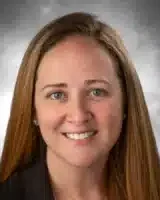
The winner of the 2026 Distinguished TCRN Award is Cassie Herman, BSN, RN, TCRN, trauma program manager at Riverside Health, a Level II trauma center in Newport News, Virginia.
This annual award is presented by the Board of Certification for Emergency Nursing (BCEN) to a Trauma Certified Registered Nurse who demonstrates exceptional commitment to clinical excellence and support for nursing specialty certification.
Cassie spoke recently with Trauma System News about her trauma nursing journey and her approach to trauma program leadership. (Interview edited for clarity.)
Q. What was your path into trauma nursing leadership?
Herman: I can’t ever remember wanting to do anything else besides being a nurse. Growing up, my mother managed an OB/GYN office, and I spent my days off of school in the office, just hanging out with the providers and the nurses. I got to know all the staff, and it was just what I always wanted to do.
I went straight into nursing school from high school, and initially I wanted to work in pediatrics. However, there was no pediatric hospital near us, so I did my preceptorship in mother-baby nursing. I loved it, but at that time they didn’t hire new grads. So my next choice was the ED, and it just clicked.
When I started, every new nurse had to have six weeks of orientation on days and six weeks on nights, and after my six weeks on nights was over, I was like, This is it, this is my home — night shift.
What I liked about the night shift was that we started busy and ended slower. I’m a perfectionist when it comes to my work, and it gave me the time to stock my pod, make sure everything was good before the next shift came in, and keep all my documentation up to date. The shift didn’t end in chaos.
And I quickly learned that trauma was my favorite part. I loved being in the trauma room — any opportunity I got, I was jumping in to help with whatever was coming in.
Our program manager at the time, Lou Ann Miller, was like my work mom. I went to her for everything. She took me under her wing and taught me everything I know, and I attribute a lot of my success to her.
After several years in the ED, I was interested in expanding my professional experience and had begun exploring other opportunities. When the Trauma PI position became available, I applied and served in that role for a little over a year before transitioning into the trauma program manager position following Lou Ann’s retirement.
Q. What is your approach to trauma program leadership?
Herman: The most important thing is to have a great team, and I think I have the best team around. We work really closely together, and we’re constantly sending each other articles because it’s really important to us to stay current. For example, we have a group in the ED called the Trauma Resource Team, which is the ED nurses who respond to all of our trauma activations. We meet with them once a month, share articles and talk about best practices.
Education is really important to me, so when I came into the PI role, I started monthly skills fairs, a rotating educational experience for the nurses on the floor. A lot of the content repeats, but that repetition is important, especially for things you’re not using often, like REBOA. We pull out all of our common trauma equipment — T-POD, REBOA, rapid infuser, chest tubes — and we also use this time as an opportunity to talk about any new policies. It’s usually about 30 minutes, and we alternate day and night shift. As a night shift nurse, I learned that night shift always gets left out of things like this, so it was important to me to include them.
We also do things like quizzes. My trauma educator printed out a little “stick figure” and different types of PPE, and she’ll say, “Alright, you have an alpha alert coming in — what PPE are you going to put on?” And they have to dress the little stick figure correctly. We try to make it fun. We’ve done escape rooms before. I think if it’s fun and entertaining, people retain it more.
Q. You run a very successful Hospital Violence Intervention Program. Could you tell us about it?
Herman: Our HVIP program is called Hand in Hand, and I oversee that program. We’re 100% grant funded across several grant streams — our staff, patient assistance, everything. We provide intensive case management to victims of community violence, with the goal of breaking the retaliation and recidivism cycle.
We have a team of five clinical intervention specialists, the bedside, boots-on-the-ground care managers. They respond whenever we have a victim of community violence come in, trying to meet that “golden hour” window. In that moment, patients are angry and thinking about retaliation, and our goal is to steer them away from that and help them see what kind of life choices will be more beneficial.
We do all kinds of things. Probably the most common is providing cell phones. Patients’ phones are often taken by the police as evidence, so for example the person can’t make doctor’s appointments, etc., so we provide a lot of cell phones. We can help with medical bills, we can help if someone is not living in a safe situation. For instance, we have helped relocate people. We provide a lot of school assistance, helping people get their GEDs, filling out applications. The goal is helping people get back on their feet and choose a more positive path.
The Hand in Hand program started in 2019, and our recidivism rate is 2 percent, which is below both the state and national average.

1 Comment
Congratulations on your award, Cassie! This is awesome and well deserved! #Virginia proud!