
When a trauma patient dies before providers have a chance to identify major injuries, the patient’s Injury Severity Scores (ISS) will often be inaccurate. Across a trauma patient population, the overall result is skewed mortality data.
At Atrium Health Carolinas Medical Center, a Level I trauma center in Charlotte, North Carolina, trauma program leaders worked with hospital, pre-hospital and public health colleagues to implement post-mortem CTs for trauma patients with an unknown cause of death.
According to trauma outcomes specialist Tracy Henry, MSc, BSN, TCRN, CCRN-K, CEN, this successful program has been disseminated to 10 other trauma centers this year.
Situation: “In our institution, approximately 80-100 patients die each year with an unknown cause of death, primarily from blunt trauma. Many of these patients die in the ED within the first 15-20 minutes of their initial resuscitation, before imaging or identification of major injuries. As a result, the majority of these cases receive an Injury Severity Scores (ISS) under 16. These inaccurately low ISS scores skewed our mortality data and did not represent the trauma population our hospital serves. In North Carolina, the medical examiner’s office does not have the resources to autopsy traumatic deaths with a clear sequence of events leading to death, with the exception of homicides which require legal documentation of injuries.”
Innovation: “This program took two years to get up and running, and it required coordination with the ED, radiology, EHR, legal and administration. After months of communication with the medical examiner’s office, we received permission to perform post-mortem CT (PMCT) on non-homicide patients who met specific criteria upon death in the trauma bay:
- Adult trauma patient (18 years or older)
- Patient died before any CT imaging was obtained
- Cause of death is uncertain
- Patient is not a homicide or suspected circumstances of foul play
- PMCT can be performed within 2 hours of death
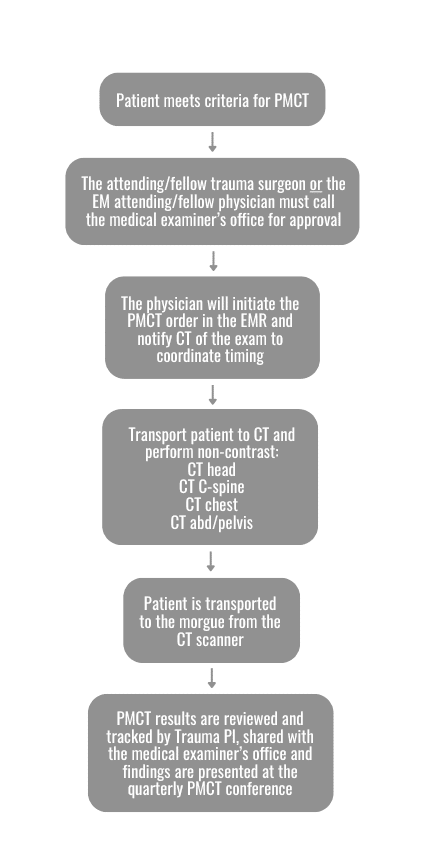
When a patient meets the above criteria, the attending physician initiates the process by calling the state medical examiner’ office to receive approval for PMCT. (See full process below.)
Results: “The biggest impact of our PMCT program has been increased accuracy in Abbreviated Injury Scale (AIS) coding of injuries, leading to more accurate ISS scores. For patients who have received a PMCT, the average increase in ISS is approximately 20. This program has been a valuable tool not only for more accurate ISS, but also as a tool for EMS performance improvement and trauma bay care. Our providers — who are often left wondering why a patient with seemingly survivable injuries died and whether they missed something or something else could have been done — have found this program provides closure, especially in cases where injuries were nonsurvivable. The program has also been a learning experience for radiologists, since post-mortem imaging is not taught as a standard and information on reading such scans is somewhat limited.”
 Originally published in the Trauma Innovation Special Report
This article was originally published in the 2026 Trauma Innovation Special Report. This special issue features the winners of the 2026 Trauma Innovation Award — a group of distinguished healthcare leaders who have developed creative solutions to problems in trauma system improvement, trauma access expansion, trauma team readiness and trauma performance improvement. To read the full issue, tap the cover image at right or click here.